





Since the introduction of IPv4 protocol in 1981 and since then, it has been the primary protocol used for connecting devices to the Internet. However, due to the increasing number of connected devices, the limited number of IPv4 addresses has become a major concern. Therefore, the internet community had to find solutions to sort out the IPv4 phasing out problem. In this blog post, we will dig deeper into answering the question” When will IPv4 be phased out ?”.
IPv4 Addresses Exhaustion
IPv4 addresses are limited to a 32-bit address space, which means that there can only be 4.3 billion unique valid IPv4 addresses. The depletion of IPv4 addresses has been a growing concern among Internet Service Providers (ISPs) for many years.
Since the number of devices connected to the internet is growing at an exponential rate due to the expansion of IoT (Internet of Things), IPv4 addresses are becoming increasingly scarce. According to the American Registry for Internet Numbers (ARIN), the pool of available IPv4 addresses was exhausted in North America in 2015. IPv4 exhaustion has created a new market where IP brokers play an intermediary role between the buyers and the sellers of IPv4 addresses blocks.
The Adoption of IPv6
IPv6 was created to overcome the limitations of IPv4 and offers a much larger address space. It uses a 128-bit address space instead of 32-bit, that provides 340 undecillion (that is, 340 followed by 36 zeros) unique addresses which is almost an infinite number.
This massive address space ensures that every device connected to the internet can have its unique IP address. However, despite the advantages of IPv6, its adoption has been slow. The main reason for this slow adoption is the lack of compatibility between the two protocols.
IPv6 is not backwards compatible with IPv4, which means that devices and networks that are built to support IPv4 cannot "No internet access "simply switch over to IPv6. This incompatibility created a sort of resistance with businesses to switch from IPv4 to IPv6 due to the lack of infrastructure.
How to Deal with IPv4 Phasing Out?
to Deal with IPv4 Phasing Out you need to:
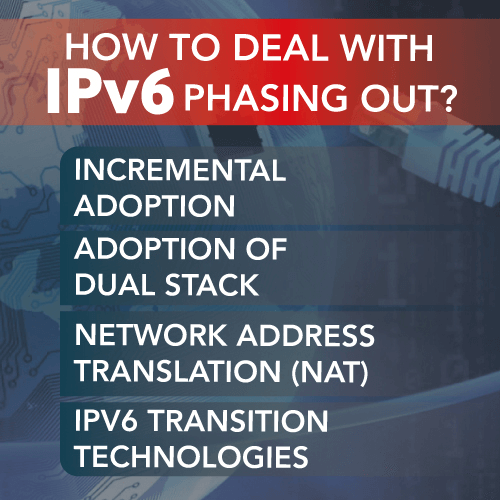
Incremental Adoption
The most practical solution is to use IPv6 in parallel with IPv4. Internet service providers can configure their networks to support both protocols at the same time. This approach will enable IPv4 and IPv6 devices to communicate with each other for a relatively long period. It also minimizes the workload on transitional mechanisms such as NAT 64 and DS-Lite.
Adoption of Dual Stack
This approach involves configuring each device with both IPv4 and IPv6 addresses. Dual stack allows the devices to communicate with both protocols and ensures that there is no loss of connectivity. Dual-stack deployment can occur at both the Internet edge and customer networks.
Network Address Translation (NAT)
NAT is currently used for IPv4 addresses to overcome the shortage of IP addresses. NAT can be used to translate IPv6 addresses to IPv4 where IPv6 is not available. However, NAT can degrade performance and compromise security in some cases.
IPv6 Transition Technologies
These technologies allow IPv6 to connect to IPv4 networks. Several technologies such as NAT64, DS-Lite, and 464XLAT are available to support the transition to IPv6. These technologies map IPv4 addresses to IPv6 addresses and vice versa.
Education and Awareness
Education and awareness play a vital role in IPv4 phasing out. Educating end-users about the benefits of IPv6 can create an appetite for IPv6 adoption. Awareness campaigns can educate people on the availability of IPv6 and its benefits.
When Will IPv4 be Phased Out?
There is no definitive timeline for the phasing out of IPv4. However, the exhaustion of IPv4 addresses, coupled with the rapidly increasing adoption of IPv6, suggests that IPv4 will eventually be phased out. The Internet Engineering Task Force (IETF) has recommended that organizations should aim to transition to IPv6 as soon as possible.
In conclusion, IPv4 exhaustion is a real problem, and replacing it with IPv6 will be a gradual process. It will require a multi-stepped approach and a significant investment in network infrastructure. However, the solutions highlighted above will help in the gradual phasing out of IPv4 addresses.