





Internet Protocol version 4 (IPv4) and Internet Protocol version 6 (IPv6) are the two main communication protocols that are used for sending and receiving data over the Internet. These protocols play a critical role in how devices communicate with each other across the internet. While IPv4 is the most widely used protocol, it faces limitations due to the shortage of available IP addresses. On the other hand, IPv6 offers a much larger address space and improved network security features. In this blog, we will discuss some details about IPv4 mapped IPv6.
What is IPv4 Mapped IPv6?
IPv4 mapped IPv6 is a transition mechanism that allows devices to communicate using both IPv4 and IPv6 addresses. It was designed to enable the coexistence of IPv4 and IPv6 networks while facilitating the switch to IPv6 after the IPv4 exhaustion. This protocol allows devices that only support IPv4 to communicate with devices that only support IPv6. The IPv4 mapped IPv6 address is a way of representing an IPv4 address in an IPv6 address format.
The IPv4 mapped IPv6 address is represented as:: FFFF:0:0/96, where the first 96 bits of the address are set to 0 and the next 32 bits are set to the corresponding IPv4 address. For example, the IPv4 address 192.168.0.1 would be represented as::FFFF: C0A8:1. This format allows for the representation of IPv4 addresses in IPv6 packets, enabling communication between devices that use different protocols.
However, there are some limitations to IPv4 mapped IPv6. The most significant drawback is that it requires additional processing time and resources to translate the IPv6 address to its IPv4 counterpart, which can result in longer latency and reduced performance in some cases.
What are the Benefits of IPv4 Mapped IPv6?
Ease of Transition
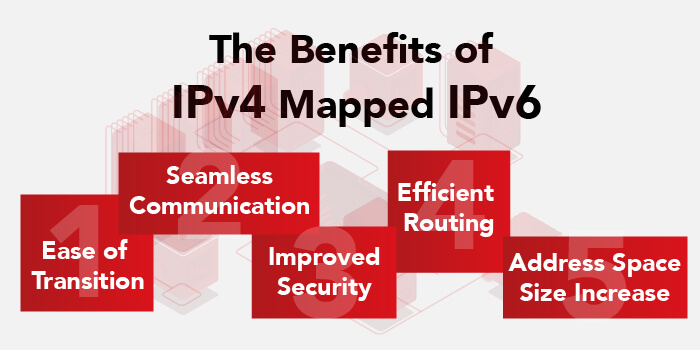
One of the key benefits of IPv4 mapped IPv6 is that it eases the transition from IPv4 to IPv6 by adding compatibility to IPv4 nodes. In doing so, it enables communication between IPv6-only nodes and IPv4-only nodes. This is particularly important at a time when there are still many devices that rely solely on IPv4. With IPv4 mapped IPv6, such devices can still communicate with the latest generation of devices that use IPv6.
Seamless Communication
Another benefit of IPv4 mapped IPv6 is the seamless end-to-end communication between devices. IPv4 mapped IPv6 allows devices on different networks to communicate with each other, making it easier to set up and manage complex networks. This is particularly important for organisations that have multiple branch locations or remote users since it enables them to access resources and services across the network easily.
Improved Security
IPv4 mapped IPv6 also offers improved security. IPv6 has stronger security features than IPv4. When IPv4 is used exclusively, it exposes networks and devices to more security challenges. However, with IPv4 mapped IPv6, devices can use the more robust security features of IPv6. This enhanced security makes it more difficult for hackers to exploit any vulnerabilities they encounter on devices using the network.
Efficient Routing
Another benefit of IPv4 mapped IPv6 is that it provides more efficient routing. Routing is crucial to any network, and IP forwarding with IPv6 is faster and more efficient than with IPv4. With IPv4 mapped IPv6, it is possible to take advantage of this efficiency without having to let go of the compatibility that IPv4 offers.
Address Space Size Increase
Finally, IPv4 mapped IPv6 provides an increase in the size of the address space, which is extremely important for addressing requirements in the modern world. The IPv6 address space is 128-bits, which is significantly larger than the 32 bits of IPv4. This means that IPv6 can support more device connections; with devices like smartphones, laptops, gaming systems, and other similar devices, IPv6 offers a more reliable addressing solution.
Overall, the adoption of IPv4 mapped IPv6 has been slow due to its limited need. However, organisations that rely heavily on IPv4-based networks may need to invest in IPv4 mapped IPv6 to enable communication with devices that only support IPv6. In conclusion, while IPv4 mapped IPv6 may not be a widely used protocol, it is a critical tool for enabling communication between devices using different protocols.