





Internet Protocol version 4 (IPv4) is a widely used network layer protocol that enables communication between different devices connected to the internet. In order to route packets between networks, routers use routing protocols.
These protocols enable communication between routers to determine the best path for transmitting data packets to their intended destinations. There are different types of routing protocols, such as Interior Gateway Protocols (IGPs) and Exterior Gateway Protocols (EGPs).
In this essay, we will discuss the various IPv4 routing protocols, their types, and their features.
What is IPv4 Routing?
IPv4 routing is the process used by routers on a network to forward data packets between devices that are connected to the Internet. When a device sends data packets to another device located on a different network, the data must be transmitted through several routers until it reaches its intended destination. IPv4 Addresses routing protocols, such as Routing Information Protocol (RIP) and Open Shortest Path First (OSPF), are used by routers to determine the best path for routing data from the source to the destination. Moreover, routing tables are used by routers to keep track of the network topology and the best routes for transmitting data packets.
What are the Types of Routing Protocols?
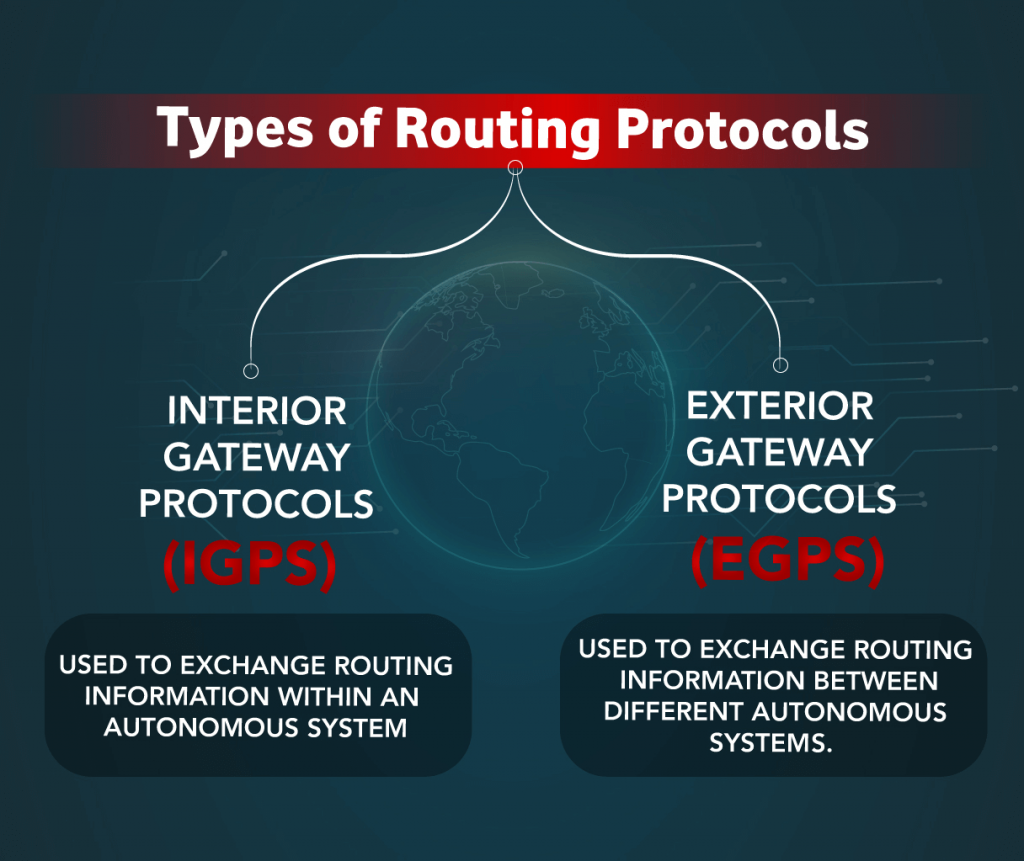
Routing protocols are typically categorized as either Interior Gateway Protocols (IGPs) or Exterior Gateway Protocols (EGPs). The two types of routing protocols are classified depending on whether they are used inside or outside an autonomous system (AS).
Interior Gateway Protocols (IGPs) are protocols used to exchange routing information within an autonomous system, while Exterior Gateway Protocols (EGPs) are used to exchange routing information between different autonomous systems.
Types of IPv4 Routing Protocols
Types of IPv4 Routing Protocols include:
Interior Gateway Protocols (IGPs)
As mentioned earlier, Interior Gateway Protocols (IGPs) are essential routing protocols that are used inside a single autonomous system (AS) in a network.
IGPs are responsible for exchanging routing information between routers within a single network, ensuring that data packets are forwarded to their appropriate destination within the network. IGPs play a crucial role in ensuring that data packets are routed efficiently within a network.
They help to prevent network congestion, reduce latency, and improve network performance. Additionally, IGPs provide redundancy, ensuring that if one router fails, the network can still function correctly.
It is essential to select the appropriate IGP based on the network size, topology, and requirements to ensure optimal network performance.
There are several types of IGPs, including Routing Information Protocol (RIP), Open Shortest Path First (OSPF), and Intermediate System to Intermediate System (IS-IS). Each protocol has its unique advantages and disadvantages, making it suitable for specific types of networks.
Routing Information Protocol (RIP)
RIP is one of the oldest IGPs. It is simple to implement which makes it ideal for small to medium-sized networks.
It uses a distance-vector algorithm, where routers exchange information on the number of hops it takes to reach a particular destination. However, RIP has a limited hop count, making it unsuitable for large networks.
Open Shortest Path First (OSPF)
OSPF, on the other hand, is a link-state protocol that is commonly used in larger networks. It uses a different algorithm that takes into account the link cost, bandwidth, and other factors to determine the best route to a destination.
It also provides features such as route tagging and load balancing. OSPF is more efficient than RIP and can handle larger networks with multiple paths.
Intermediate System to Intermediate System (IS-IS)
IS-IS is another link-state protocol that is similar to OSPF but is commonly used in service provider networks. It is more scalable and can handle larger networks with multiple paths, making it suitable for internet service providers.
Interior Gateway Routing Protocol (IGRP)
IGRP is a proprietary Cisco protocol used to exchange routing information within an autonomous system. It calculates the best path based on various metrics such as bandwidth and delay.
Exterior Gateway Protocols
As discussed above, Exterior Gateway Protocols (EGPs) are routing protocols that are used to exchange routing information between different autonomous systems (AS) in a network. EGPs are responsible for routing data packets between networks, ensuring that data is transmitted efficiently and accurately across the internet.
There are two primary EGPs: Border Gateway Protocol (BGP) and Exterior Gateway Protocol (EGP). EGP is an older protocol that is no longer widely used, while BGP is the most commonly used EGP today.
BGP is a path-vector protocol that uses a complex algorithm to determine the best path for data packets to follow between different networks.
It is designed to manage the inter-domain routing of internet traffic, making it a critical protocol for internet service providers (ISPs) and large organizations with multiple networks.
BGP allows networks to advertise their IP prefixes and routes to other networks, enabling data packets to be routed efficiently between networks.
BGP requires a high level of expertise to configure and manage. One of the most significant challenges with BGP is the potential for routing loops and instability, which can lead to network congestion and performance issues.
BGP also requires a significant number of resources, including memory and processing power, making it challenging to implement on smaller networks.
However, despite its complexity, BGP is an essential protocol for the internet and plays a crucial role in ensuring that data is transmitted accurately and efficiently between different networks.
BGP is responsible for managing the inter-domain routing of internet traffic, ensuring that data packets are routed through the most optimal path between different networks.
How does IPv4 Routing Work
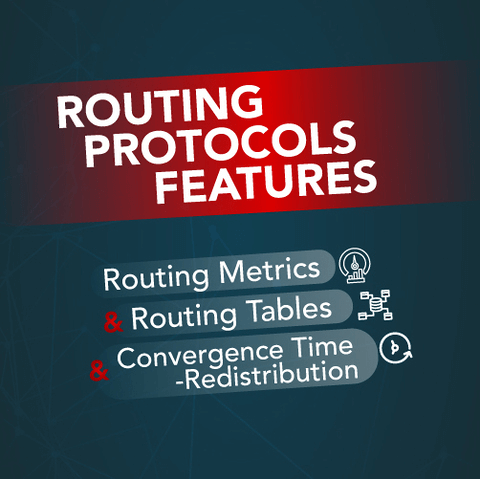
Routing protocols have several features that enable routers to communicate effectively and determine the best path for transmitting data packets. Some of these features include:
Routing Metrics
Routing protocols use metrics to determine the best path for transmitting data packets. Metrics can be based on factors such as bandwidth, delay, hop count, and route reliability.
Routing Tables
Routers use routing tables to store information about the best path to a destination. Routing tables are updated dynamically based on changes in the network topology.
Convergence Time
Convergence time refers to the time it takes for routers to update their routing tables in response to changes in the network topology. A routing protocol with a low convergence time is considered more efficient.
Redistribution
Redistribution is the process of exchanging routing information between different routing protocols. For example, a router can use OSPF to exchange information with other routers within an autonomous system, and use BGP to exchange information with routers in other autonomous systems.
Conclusion
IPv4 routing protocols are an essential part of modern computer network administrator . They enable routers to communicate and determine the best path for transmitting data packets between devices connected to the internet.
IGPs and EGPs are the two main types of routing protocols used in computer networks. They both have their unique features and advantages. It is important to choose the right routing protocol based on the size and complexity of the network.