




Many moons ago, humanity invented the Internet as a way of communication. It was revolutionary—building an interconnected network that would forever change how we share information, conduct business, and build relationships across the globe.
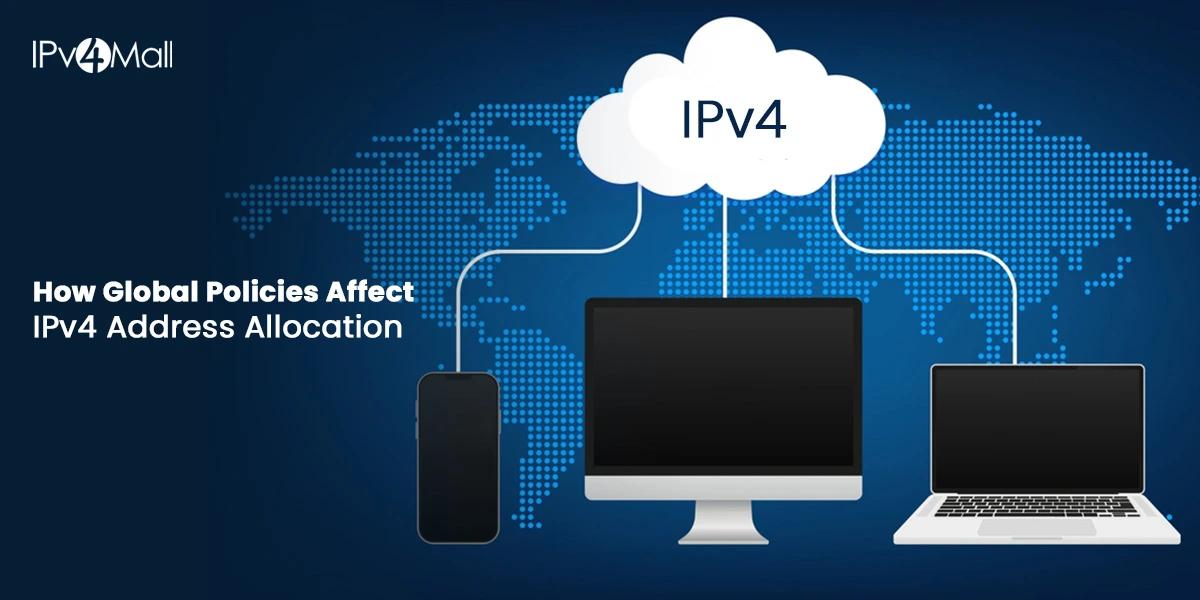
As it continued to grow and glow with thousands of millions of devices connected to it, we found ourselves in a bit of a situation: we’ve exhausted the system of unique numerical addresses known as IPv4 addresses that connect devices to the internet. This situation has led policymakers and network administrators to implement various strategies to efficiently manage and allocate IPv4 addresses.
In this article, we discuss how global policies influence IPv4 address allocation, the challenges these policies address, and the future of IP address management. So, shall we?
IP Address Allocation: Explained
- IPv4 addresses are 32-bit numbers, giving about 4.3 billion unique addresses. That might have seemed a lot when the internet was small, but these days, with the fast growth of internet-connected devices, the demand increased for these addresses.
- To manage the allocation of these limited resources, the Internet Assigned Numbers Authority (IANA) is responsible for distributing IPv4 addresses globally. IANA allocates blocks of IP addresses to Regional Internet Registries (RIRs), which are organizations that manage IP address distribution within specific regions.
- These RIRs allocate IP addresses to local internet registries (LIRs) and Internet Service Providers (ISPs), who then assign them to end users.
How Do Global Policies Change the Game?
The scarcity of IPv4 addresses has led to global policies and initiatives. Their key objectives include conserving remaining IPv4 addresses, ensuring fair distribution of them, encouraging the transition to IPv6, and assisting in the continued operation of the Internet.
Fair Distribution
- With the increased scarcity of IPv4 addresses, global policies focused on a policy of fair distribution.
- The principle of "needs-based allocation" was introduced, ensuring that organizations receive IP addresses based on demonstrated needs rather than on a first-come, first-served basis.
- This prevents hoarding and makes sure the addresses are available for legitimate uses.
Conservation Strategies
- Network Address Translation (NAT) is used to conserve IPv4 addresses. With NAT, several devices can share one public IP address.
- Network operators can reduce the number of addresses they have to manage by combining many little ranges of IP addresses into a single large range.
- When an organization releases unused IP addresses, they can be recycled and reallocated to other entities via IPv4 address transfer markets.
- Policies and strict oversight are in place to prevent fraud and ensure that address transfers adhere to regional policies.
Inter-RIR Coordination
- Since the internet is a global entity, inter-RIRs are necessary for consistent policy execution.
- Policies are developed from a bottom-up, consensus-driven process comprising several stakeholders, including governments, private companies, and civil society.
- This cooperation ensures that global policies are aligned across different regions, promoting fairness and stability in IP address allocation.
IPv6 Deployment
- IPv6 Transition: The use of the new version of IP, known as IPv6, has also been widely propagated by various organizations in most countries. It has a much larger address space.
- Dual Stack: This involves the simultaneous operation of both IPv4 and IPv6 protocols, enabling a smooth and gradual transition.
Looking Into the Future: IPv4 and the Transition to IPv6
- Despite these efforts, the shortage of IPv4 addresses remains one of the biggest challenges. Continued Internet growth, together with the increasing number of connected devices, will increasingly put pressure on available address space.
- Moving to IPv6 addresses is the long-term solution to combat exhaustion. Using 128-bit addresses, IPv6 allows for a virtually limitless supply of unique IP addresses.
- The transition to IPv6 has been slow due to several factors, including the cost of upgrading infrastructure and the lack of immediate benefits for organizations already using IPv4.
- To make this transition seamless, international policies have been developed that allow the adoption of IPv6 while continuing to ensure the usability of the current IPv4 addresses.
That’s all, folks! These global policies governing the allocation of IPv4 addresses are crucial to both the management of this finite address space and to the continued proper operation of the Internet.
The challenge brought about by the shortage of IPv4 addresses is being met through the implementation of strategies like the deployment of IPv6, address conservation, and efficient distribution.
If you want to buy an IPv4 address, trust IPv4Mall to provide you with the best IP address solutions.
FAQs
- How are IPv4 addresses allocated?
IPv4 addresses are allocated hierarchically by the Internet Assigned Numbers Authority (IANA) and its Regional Internet Registries (RIRs). The IANA assigns blocks of addresses to the RIRs, which in turn allocate them to Internet Service Providers (ISPs), businesses, and other organizations.
- What is IPv4 addressing structure?
An IPv4 address is a 32-bit number typically written in dotted-decimal notation. This notation consists of four octets (8-bit groups) separated by periods. Each octet can range from 0 to 255. Example: 192.168.1.1