






As technology continues to evolve, businesses and organisations have become increasingly reliant on the Internet to support their day-to-day operations. Multiprotocol Label Switching (MPLS) has emerged as a key networking technology that offers businesses a reliable way to connect their sites and facilities across different geographic locations. In this blog post, we will have a further look at Connecting MPLS networks.
What is MPLS?
Multiprotocol Label Switching (MPLS) is a high-performance telecommunications technology that fundamentally improves the efficiency and reliability of traffic routing in data networks. It is a protocol that operates at the OSI Layer 2 (data link layer) and Layer 3 (network layer) levels of the communication stack.
The basic idea behind MPLS is to simplify the routing process by replacing complicated layer 3 routing protocols with a more streamlined framework that uses labels to forward packets. Essentially, MPLS adds a layer of abstraction on top of IP routing to make it more efficient and faster.
The MPLS labelling system works by attaching short, fixed-length labels to each packet as it enters the MPLS network. These labels are used to identify the packet's destination and route it through the network to its final destination. By using labels instead of complex routing tables and protocols, MPLS can speed up network routing and improve overall network performance.
Why do we use MPLS in Networks?
Improved Communication
One of the key advantages of connecting MPLS networks is the ability to establish seamless communication between geographically dispersed business locations. Typically, MPLS networks are deployed in one location, and each location has its own MPLS network. By connecting these networks, businesses can create a secure, high-speed, and reliable wide-area network that enables communication and collaboration between different locations. This is particularly beneficial for multinational organisations that need to share data and applications across borders.
Enhanced Security
Another key benefit of connecting MPLS networks is enhanced security. MPLS provides inherent security features, and an MPLS VPN (Virtual Private Network) offers an additional layer of security and isolation. Each VPN is logically separated from other VPNs running on the same network, which ensures that the traffic between them does not mix. By connecting MPLS networks, businesses can create a highly secure network topology that is resistant to threats and provides secure access to data and applications.
Scalability
Connecting MPLS networks also provides scalability benefits to organisations. You can add new locations to the network without provisioning new connectivity services. This means that businesses can cost-effectively scale their operations while maintaining high network performance. By connecting MPLS networks, businesses can move from a hub-and-spoke topology to a mesh topology, which means that each location can communicate with any other location without having to go through a centralised hub.
Better QoS
One of the key advantages of MPLS is its ability to prioritise traffic by applying different levels of service quality to different types of traffic. MPLS supports different types of traffic management, Quality of Service (QoS) policies, and traffic engineering. These features enable businesses, service providers, and network administrators to ensure that critical applications, like video conferencing or VoIP, receive priority treatment over less time-critical applications, like email or web browsing.
Steps of Connecting MPLS Networks
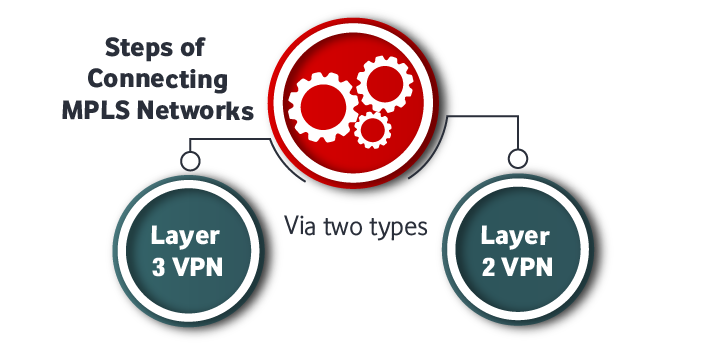
To connect MPLS networks, the first step is to choose a service provider that can provide MPLS connectivity to your local and wide area network. The service provider must have a global MPLS network with Point of Presence (PoPs) in your area. Once you have selected a provider, you can establish a Virtual Private Network (VPN) connection between your MPLS-enabled equipment and the service provider's MPLS network.
To configure an MPLS VPN, the network operator has to establish the routing protocols and policies that will determine how traffic is forwarded between networks. Two types of VPNs can operate across MPLS networks:
- Layer 3 VPN – This VPN operates on Layer 3 of the OSI model and provides connectivity between routers. It is ideal for organisations with multiple locations that require Layer 3 connectivity between their network devices.
- Layer 2 VPN – This VPN operates on Layer 2 and provides a transparent connection between end devices. It is ideal for organisations that require a transparent link between their LANs and the WAN.
The connection between MPLS networks is achieved by creating LSPs that connect VPNs across various service provider networks. The LSPs are created based on the traffic engineering requirements of the network operator, and the paths can be optimised for label switching, load balancing, and recovery.
In summary, MPLS is a powerful and versatile networking technology that provides a range of benefits to both service providers and end-users. It simplifies the routing process, increases network performance, prioritises traffic flow, and enhances network security. As such, it has become a widely adopted technology in the telecommunications industry and is expected to continue to play an essential role in the future of networking and communication.